
November 19, 2025
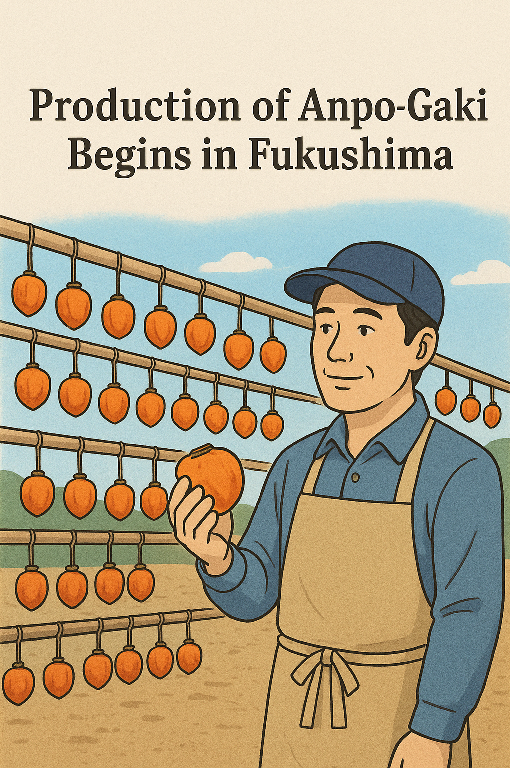
In Fukushima Prefecture’s Date City—known as the birthplace of Anpo-gaki, Japan’s beloved semi-dried persimmon—the annual production season has just begun. In the rural district of Yanagawa, farmer Yohei Shishido has started preparing this year’s harvest, filling his drying racks with rows of bright orange persimmons that signal the arrival of autumn.
Anpo-gaki is not an ordinary dried fruit. Unlike the firm, fully dried persimmons commonly found in Japan, Anpo-gaki is made to retain a high level of moisture, giving it a soft, jelly-like texture and a naturally rich sweetness. Many visitors describe it as “a Japanese fruit dessert that tastes like a blend of jam and dried fruit.”
The process is rooted in local tradition. Freshly peeled persimmons—typically from the astringent “Hachiya” variety—are gently exposed to sulfur smoke for about 30 minutes, a method historically used to prevent mold. They are then hung outdoors in well-ventilated drying houses for about a month. During this time, the fruit slowly concentrates in flavor, reaching a sugar level of around 50 degrees Brix, resulting in the signature juicy, amber-colored Anpo-gaki.
At Shishido’s farm, long strings of persimmons hang in multiple layers, glowing like lanterns against the crisp air. He hopes more people, including international visitors, will discover their appeal: “They’re healthy and delicious—please enjoy the natural sweetness,” he says.
Shipments are expected to begin in mid-December, with around 70,000 pieces planned for production through February. For travelers visiting Tohoku in winter, Anpo-gaki is a unique seasonal treat that captures the region’s craftsmanship, climate, and deep food culture.
福島にてあんぽ柿の生産が始まる・・・日本のソフトでジューシーな半生干し柿
福島県の伊達市――あんぽ柿(日本で愛される半生干し柿)の発祥地として知られる――では、毎年の生産シーズンがちょうど始まりました。梁川地区の農家・宍戸洋平さんは今年の収穫の準備を始め、秋の訪れを示す明るいオレンジ色の柿が並ぶ干し場をいっぱいにしています。
あんぽ柿は普通の干し柿ではありません。日本で一般的に見られる、固く完全に乾燥した干し柿とは異なり、あんぽ柿は高い水分を保つように作られ、柔らかくゼリーのような食感と自然に濃厚な甘みを持ちます。多くの訪問者はその味を「ジャムとドライフルーツが混ざったような日本のフルーツデザート」と表現します。
その製法には地域の伝統が根付いています。渋柿――通常は「蜂屋柿」――を皮むきした後、カビを防ぐために約30分間、やさしく硫黄の煙にさらします。続いて、風通しの良い干し小屋で約1か月間吊り下げられます。その間に果実はゆっくりと風味を凝縮させ、糖度がおよそ50度に達し、あんぽ柿特有のジューシーで琥珀色の実になります。
宍戸さんの農園では、長いひもに吊るされた柿が何層にも連なり、澄んだ空気の中でランタンのように輝いています。彼は、国際的な訪問者を含め、より多くの人があんぽ柿の魅力を知ってくれることを願っています。「体に良くておいしいですよ――自然な甘さを楽しんでください」と語ります。
出荷は12月中旬に始まる予定で、来年2月までに約7万個の生産が見込まれています。冬に東北を訪れる旅行者にとって、あんぽ柿は地域の職人技、気候、そして深い食文化を凝縮した独特の季節の味覚といえるでしょう。